ATLANTA-Jasmine Marbutt pushes open the door to Switchyards with a sense of familiarity. She heads straight for the coffee station and fills a cup while scanning the busy room for a place to sit. Around her, the space is alive in a quiet and steady way. Laptops are open and conversations are subtly drifting between tables.
She doesn’t know everyone here, but she recognizes enough faces to feel like she belongs.
Settling into a chair, she takes a sip of tea and greets the familiar face next to her.
For Marbutt, a student and regular at the Atlanta-based co-working space, Switchyards is more than just somewhere to get work done. It’s part of her routine and a place where she can exist alongside others. Switchyards has become a small but meaningful source of connection in a city where that can sometimes feel hard to find.
While Switchyards has 13 locations across the Atlanta area, the Midtown location is where Marbutt feels most at home.
“I do feel a sense of community here,” Marbutt said. “I see a lot of students from other schools. I’ve brought friends and met others through them that work at Switchyards.”
That sense of familiarity, the simple act of recognizing faces and sharing a space is exactly what defines a “third space.”
The concept is simple. A “first space” is home. A “second space” is work or school. A “third space” is something in between like a cafe, a bar, a bookstore, or a co-working space. It’s anywhere people choose to gather outside of their obligations.
Unlike offices or classrooms, third spaces are voluntary spaces. People go because they want to be there, not because they have to. They are spaces that encourage socializing and connecting with others.
For much of the 20th century, these spaces were common and woven into everyday life. However, over time, many began to disappear. This can be attributed to rising costs and technological advancements. An increase in digital communication made it easier and more convenient for people to simply stay home.
Then the pandemic hit.
Overnight, the spaces that once supported everyday interaction were gone. Coffee shops closed their doors. Offices emptied. Campuses went virtual. For months, home became the center of work, school, and social life for nearly everyone.
Even after the city reopened, something changed.
Remote work remained widespread, and students spent less time on campus. While these shifts brought flexibility, they also reduced the number of in-person interactions people once experienced daily.
In 2023, the U.S. Surgeon General’s Office issued an advisory warning that loneliness had become a significant public health concern. The report found that nearly one in two U.S. adults reported experiencing loneliness, representing a sharp increase in the years following the pandemic. The report noted that prolonged isolation carries risks comparable to those of smoking and other serious health factors.
For younger adults, especially students and young professionals, the effects have been particularly noticeable. Without consistent workplaces or campus environments, many have lost the informal interactions that once shaped their daily routines and provided that essential human connection.
That loss has created a growing demand for something simple: a place to go.
Spaces like Switchyards are emerging to meet that need.
“This space is surrounded with so many other people, and it helps me get in the right mindset to be productive,” Marbutt said. “There are also private phone booths and meeting rooms so I can have private conversations or quiet areas instead of being disturbed at home.”
She describes it as something closer to a coffeehouse than a workplace.
“Switchyards is a cozy, coffee-house style environment that helps boost my creativity and focus,” she said.
But what keeps her, and many others, coming back is not just productivity. It’s the feeling of being around other people.
Third spaces offer a kind of interaction that exists somewhere between isolation and obligation.
At home, people are often alone. At work or school, interactions are required. Third spaces allow for the in-between: connection without pressure.
At Switchyards, someone can spend hours working quietly without speaking to anyone. Or they can strike up a conversation with a stranger. Over time, those strangers become familiar faces.
For Marbutt, that familiarity matters.
“I see a lot of students from other schools,” she said. “I’ve brought friends and met others through them that work at Switchyards.”
Marbutt believes spaces like this are becoming more common in Atlanta for a reason.
“Spaces like this are definitely becoming more common in Atlanta because so many people work from home and they’re a great place to go to as a student,” she said. “Even Switchyards has been expanding and opening so many new locations around Atlanta and different states.”
That demand for connection is showing up in different ways around the city. While some seek out calm and peaceful environments, others are drawn to places that offer something more lively.
One of Atlanta’s most well-known examples is Sister Louisa’s Church of the Living Room & Ping Pong Emporium, often simply called “Church.” Church offers a completely different type of third space than Switchyards.
The walls are covered in irreverent religious artwork and mismatched furniture fills the space. It’s not quiet, and it’s definitely not predictable. But for many, that’s exactly the point.
“I think people stopped caring about other people in a good way,” said Natalie Mason, a regular at Church. “I was first introduced to Church by my friend Maelee and she said you could show up in a nun outfit or just coming in from work and no one will condemn you for it. And it’s true.”
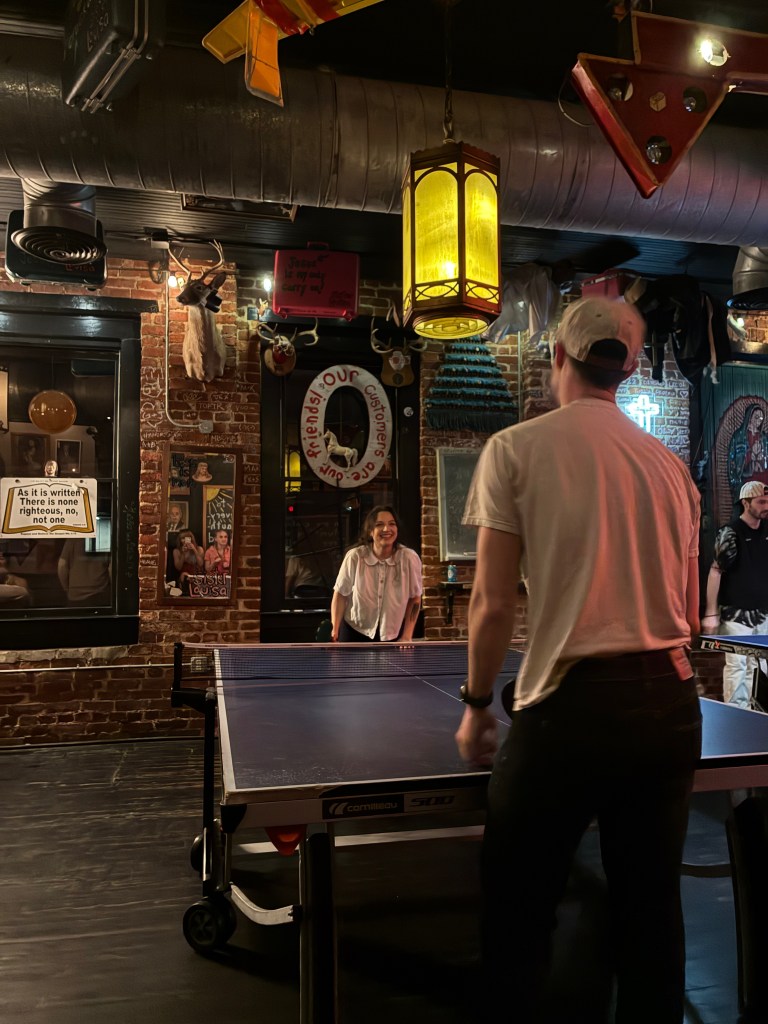
Church creates a space for people to simply exist as they are.
“It’s a bar with homoerotic innuendos and lots of clowns everywhere,” Mason said.
The description is unconventional, but so is the experience.
“I do feel a sense of community at Church,” Mason said. “Even if it’s dead inside, there’s still an ambiance to it. It’s easy to talk to the people there because of the laid back environment. No one is uptight. There seems to be a sense of understanding when meeting new people there.”
“That sense of understanding, you can feel it right away,” she added. “If you’ve never been inside and you walk in from the street, you can gather the atmosphere from looking at any art on the wall. Also, there’s no fee to get inside which is always a plus,” she said.
While Switchyards and Church offer entirely different environments, they serve the same purpose. Both spaces create opportunities for people to share a space and to connect.
As residents across Atlanta continue to search for connection, third spaces are becoming more common.
“Spaces like this are definitely becoming more common in Atlanta because so many people work from home,” Marbutt said. “Even Switchyards has been expanding and opening so many new locations around Atlanta and different states.”
That growth reflects more than a shift in work culture. It signals a deeper need for connection in a city where people are constantly moving. As Atlanta continues to expand, these spaces are helping people find small moments of familiarity in an otherwise fast-paced environment.
Whether it’s a quiet co-working space or a lively bar filled with conversation, third spaces give people a sense of belonging.
Inside Switchyards, that connection doesn’t always look like conversation. It looks like recognition through a nod across the room or a shared table. The comfort of knowing you’ve been there before, and that you’ll likely see some of the same faces again.
For Marbutt, that familiarity is what keeps her coming back.
“I love the ambiance,” she said. “It just feels good to be here.”
In a time when loneliness has become a national concern, spaces like Switchyards and Sister Louisa’s Church of the Living Room & Ping Pong Emporium are offering something that can’t be replicated online. They offer community and a reminder that, even in a city as large as Atlanta, no one has to feel completely alone.

Leave a comment